How Railway Timetables Made Greenwich Time Britain’s Standard
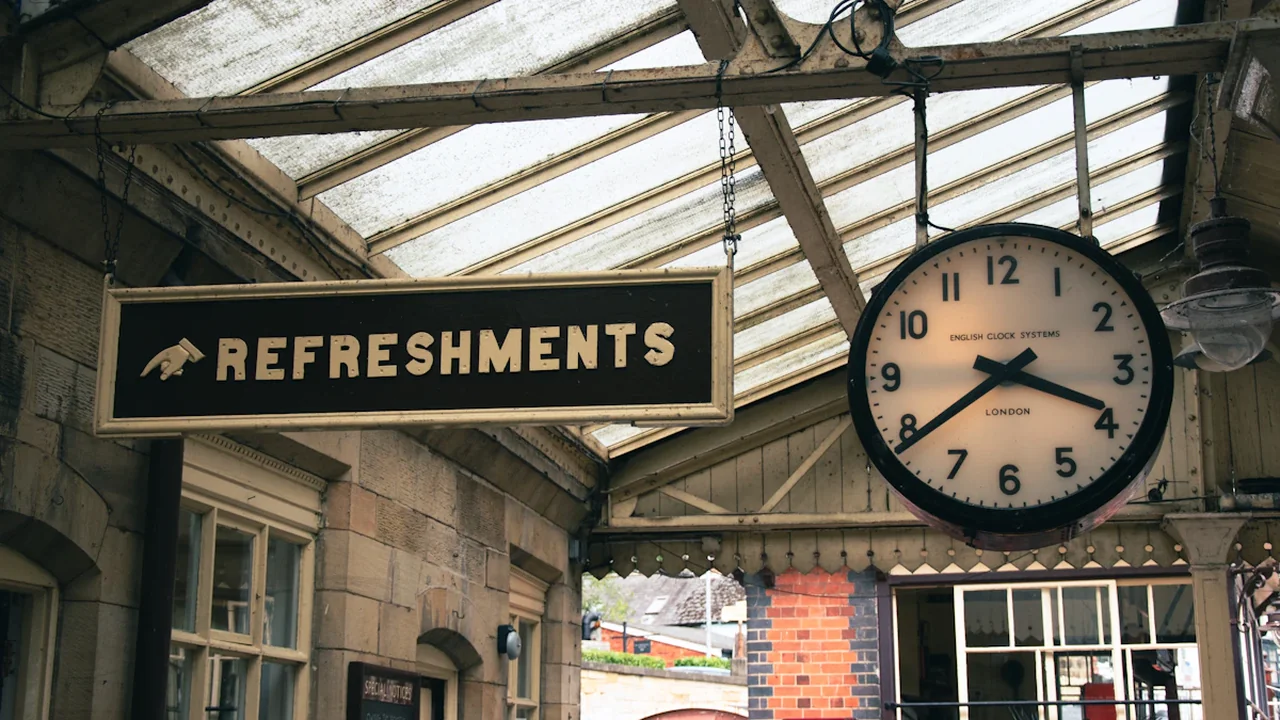
A train timetable only works if passengers and railway staff agree on what the clock says. In nineteenth-century Britain, local clocks showed different times from place to place, making journeys harder to coordinate. Railway companies increasingly adopted Greenwich Mean Time (GMT), helping establish a shared standard for everyday travel.
Local clocks made railway journeys harder to coordinate
Before standard time, towns set their clocks by local solar time: noon was tied to the sun’s position in that place. Because the sun reaches its highest point at slightly different moments across Britain, clocks in different towns did not show exactly the same time.
That variation was manageable when most journeys were local. Railways connected places more quickly and made precise departures and connections part of daily life. A timetable based on one town’s clock could cause confusion for passengers travelling from another, while railway operations needed a consistent way to schedule trains. A passenger trying to catch a train therefore faced a simple question with no shared answer: which town’s clock did the printed departure time follow?
Royal Museums Greenwich describes these differences in local time as a problem that helped drive the adoption of standard time based on the Greenwich meridian. The issue was practical: people needed clocks and timetables to agree across distance. The source places the change in the context of railway timekeeping, rather than attributing it to a single timetable or one local decision.
Railway companies adopted Greenwich Mean Time
Greenwich Mean Time takes its reference from the Prime Meridian at Greenwich. Railway companies began using it as a common standard, and by the 1840s most railway companies had adopted GMT, according to Royal Museums Greenwich.
That change made timetables easier to use across routes. A departure time could refer to the same standard in different places, reducing the mismatch between local clocks and railway schedules. The shared time also helped passengers plan connections without having to account for each town’s separate clock. For railway staff, using one reference made it easier to coordinate journeys that crossed local boundaries.
The railway network therefore gave standard time an everyday purpose before it became part of a wider international framework. Greenwich was useful not simply as a place on a map, but as the reference point from which a common time could be communicated. The chronology also shows that standard time was adopted gradually by railway companies; the source does not describe it as an overnight change to every clock in Britain.
The 1884 conference gave Greenwich an international role
The move from railway practice to international agreement came later. In 1884, the International Meridian Conference established Greenwich as the Prime Meridian and recommended a global time-zone system based on GMT, Royal Museums Greenwich says.

A prime meridian is the reference line for measuring longitude. It provides a geographic starting point for mapping the world; it is not itself a clock change or a seasonal rule. The conference’s recommendation helped connect the Greenwich reference to a system for organizing time across different parts of the globe.
The sequence matters: British railway companies had largely adopted GMT by the 1840s, while the international conference established Greenwich’s prime-meridian status in 1884. The later agreement built on the usefulness of a shared reference, rather than creating the original railway solution. For readers, that separates two related milestones: railways made a common time useful for journeys, and the conference gave Greenwich a formal international role.
Greenwich Mean Time is a reference, not daylight saving
GMT is often confused with seasonal clock changes, but they are different ideas. GMT is a time standard tied historically to Greenwich. Seasonal clock changes move civil clocks forward or back for part of the year; they do not change where the Prime Meridian is or what longitude means.
That distinction helps explain why Greenwich remains relevant even when people encounter different clock settings through the year. A meridian supplies a fixed geographic reference. Local rules determine whether clocks temporarily show a different civil time. The history described here concerns the establishment and use of a shared reference; it does not explain the details of seasonal clock-change rules.
Why the railway story still matters
Modern travel depends on coordinated schedules, and shared time remains part of how transport and communication work across distance. The original railway problem is familiar: when people use different clocks, agreeing on when something happens becomes harder. A standard reference allows a timetable to communicate the same departure time across places, which is essential when a journey involves more than one town.
Greenwich’s place in that history links an ordinary task—catching a train—to a global convention. Railway timetables helped make one common time useful in Britain, and the 1884 conference gave Greenwich a formal international role as the Prime Meridian. This chronology is based on Royal Museums Greenwich’s account of the history of the Royal Observatory and timekeeping.
Source: Royal Museums Greenwich
Context & actions About this article
Source check Historical context
Royal Museums Greenwich describes the railway adoption of GMT and Greenwich’s later international role.
- Railway companies’ adoption of GMT by the 1840s
- The International Meridian Conference in 1884
- The distinction between the Prime Meridian and seasonal clock changes
- Source
- Royal Museums Greenwich
- Scope
- Greenwich, London
- Updated
- 2026-10-08 13:29
Source check
Report a trust issue
Send a clear signal to community moderation if the source, facts or context need review.


Comments