How to Compare UK Fuel Prices Before a Long Drive

Before a longer drive, compare petrol or diesel prices along your route and count the cost of getting to a cheaper forecourt. A low listed price may be a false saving if the detour uses extra fuel, and a supermarket offer may have conditions that change what you actually pay.
Where to check petrol and diesel prices
Start with a fuel-price comparison service that lets you search by postcode and select petrol or diesel. Check the price, forecourt address and when the listing was last updated. Prices can change, and a result may be out of date by the time you arrive.
The Competition and Markets Authority (CMA) publishes material about its UK road fuel market study and fuel price monitoring work. Its collection is useful for understanding the CMA’s monitoring and market work; it is not a live quote for a particular pump. Check a current local listing, then confirm the price at the forecourt before filling up.
Search around your starting point, destination and likely route. A postcode search can identify nearby options, but a station that appears close on a map may sit on the other side of a dual carriageway or require leaving the route. Check the actual road journey, not just the straight-line distance.
Compare like with like
For a useful comparison, keep the details consistent:
- Choose the fuel your vehicle uses: petrol and diesel prices are not interchangeable.
- Compare the same unit, usually pence per litre, and note the time or date shown for each listing.
- Check the forecourt’s location and opening hours against your route and planned stop.
- Look for any price conditions, such as a membership requirement or minimum purchase.
A difference of a few pence per litre can look significant, but the saving depends on how many litres you buy. If you only need a small top-up, a longer diversion is less likely to pay off than when you are filling a larger tank.
Calculate the cost of a detour
Work out the extra round-trip distance from your route to the cheaper station and back. Estimate the fuel that distance will use using your car’s realistic fuel economy, then multiply by the price per litre you expect to pay. Compare that detour cost with the saving from the cheaper pump price.
For a simple estimate, convert miles per gallon to litres per mile by dividing 4.546 by your vehicle’s miles per gallon. Multiply the result by the extra miles and by the fuel price in pounds per litre. This is an estimate: traffic, speed, hills, load and driving style affect consumption.
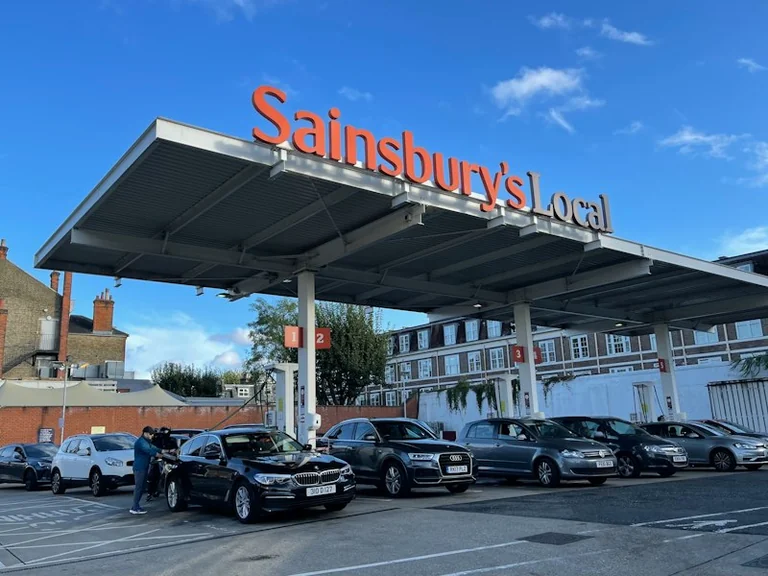
Hypothetical example
Suppose a driver plans to buy 40 litres. One forecourt is hypothetically priced at 150p per litre and a second, off-route forecourt at 146p per litre. The pump-price difference is 4p per litre, so the gross saving on 40 litres would be £1.60.
If reaching the cheaper station adds 8 miles in total and the car averages 40 miles per UK gallon, those miles use about 0.91 litres. At a hypothetical 146p per litre, that detour fuel costs about £1.33. The net saving is roughly 27p, before allowing for time or any extra congestion. These figures are illustrative only, not live prices.
If the detour were longer, fuel economy worse, or the amount bought smaller, the cheaper listing could cost more overall. A station directly on the route may therefore be the better-value choice even when its displayed price is higher.
Check supermarket offer conditions
Treat a supermarket promotion as a conditional price until you have checked the terms. Confirm whether you need a loyalty card, a minimum shop, a voucher or a particular payment method. Check the offer’s dates, eligible fuel types, participating locations and any cap on the discount.
Also ask whether the offer applies to the litres you plan to buy and whether you would make the qualifying purchase anyway. If you must spend extra or travel out of your way to unlock a discount, include those costs in the comparison. Use the effective price you can actually obtain, not the headline saving alone.
Make the final check before leaving the route
Shortlist a couple of suitable forecourts and check their listings again before setting off or when you make a safe stop. Confirm the pump price on site, and recalculate if the price, route or planned amount changes. For a longer journey, the best option is the one that gives you a genuine overall saving while fitting your route and timing.
Source: Competition and Markets Authority
Context & actions About this article
Source check Price-check method
The CMA provides material on UK road fuel monitoring; local forecourt prices and offer terms should be checked directly because they can change.
- Compare the same fuel type and price unit
- Check the listing time and forecourt location
- Confirm offer eligibility and current pump price
- Include the detour’s fuel cost
- Source
- Competition and Markets Authority: Road fuel market study
- Scope
- United Kingdom
- Updated
- 2026-10-30 09:57
Source check
Report a trust issue
Send a clear signal to community moderation if the source, facts or context need review.


Comments